
Compare orthopaedic sandals and regular sandals by footbed shape, cushioning, heel stability, adjustable straps and suitability for everyday wear.
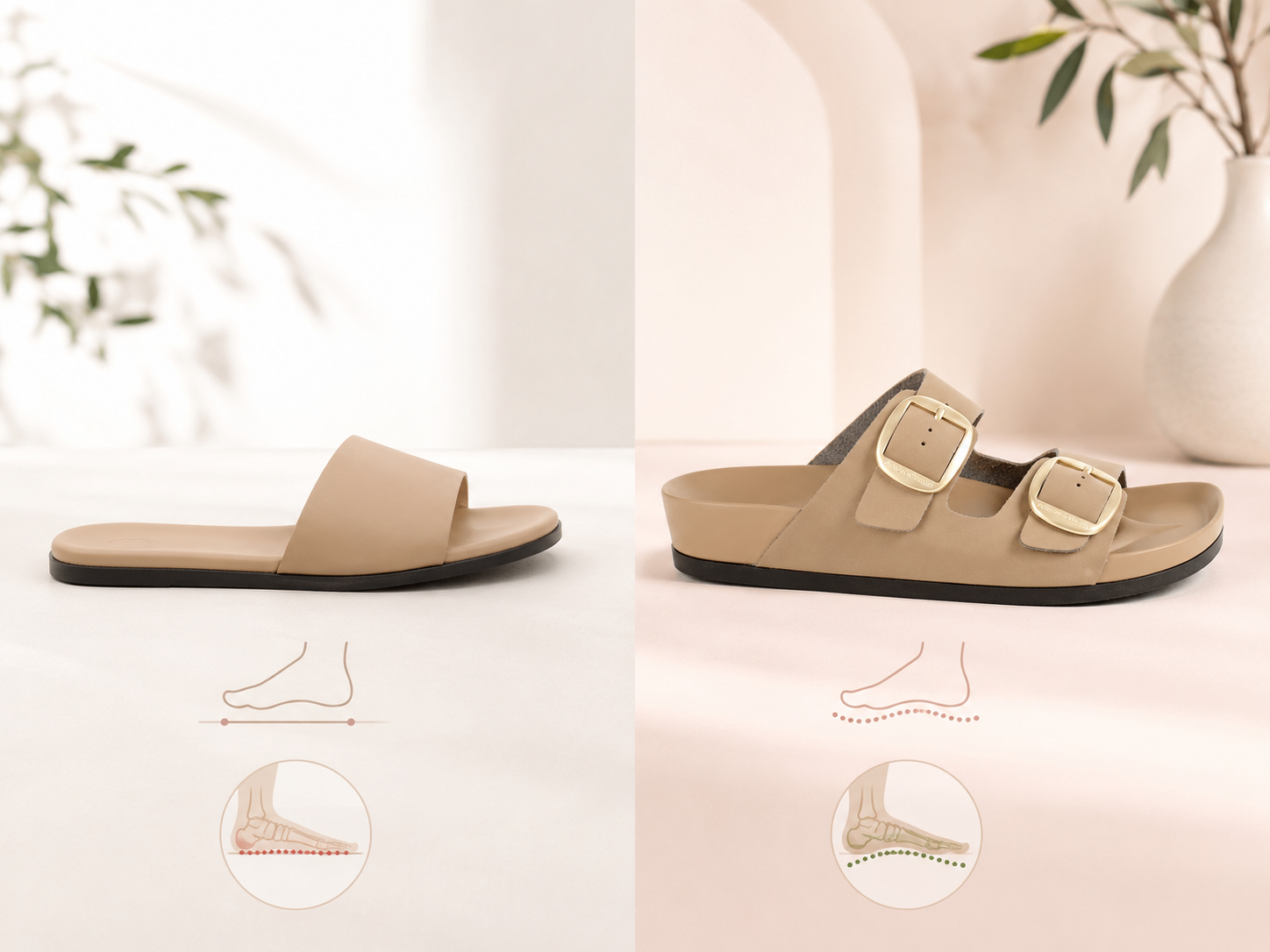
The main difference between supportive orthopaedic-style sandals and basic fashion sandals is usually their structure.
Supportive sandals often include a contoured footbed, a more stable sole, adjustable straps and cushioning designed for longer periods of daily wear. Regular sandals may focus more heavily on appearance, lightweight construction or short-term casual use.
However, the word “orthopaedic” alone does not guarantee that a sandal is suitable for every person. Correct fit, comfort and construction should still be evaluated carefully.
| Feature | Supportive Orthopaedic Sandal | Basic Regular Sandal |
|---|---|---|
| Footbed | Usually shaped or contoured | Often flat or lightly shaped |
| Arch Area | More defined support | Minimal or no support |
| Heel Position | Often deeper or more stable | May be shallow or loose |
| Straps | Frequently adjustable | May be fixed or decorative |
| Sole | Structured cushioning and support | May be thin, flat or very soft |
| Typical Use | Extended everyday comfort | Short-term casual or fashion wear |
A completely flat sandal may provide limited contact beneath the arch. A supportive sandal often uses a shaped footbed designed to distribute pressure over a broader area of the foot.
The contour should feel comfortable and supportive. It should not create sharp pain or excessive pressure beneath the arch.
Some supportive sandals include a shaped heel area that helps keep the foot centred. A very flat or loose sandal may allow the heel to move from side to side during walking.
Better heel stability can be especially useful when walking for longer periods or on slightly uneven surfaces.
Adjustable straps help accommodate different foot widths and instep heights. They also allow the sandal to hold the foot more securely.
A sandal that fits securely may reduce the need to curl or grip with the toes to keep it in place.
Regular sandals may use a single soft layer that feels comfortable initially but provides limited structure. Supportive sandals generally aim to balance cushioning with a more stable base.
For everyday walking, the front of the sandal should allow natural movement while the middle of the sole remains reasonably stable.
Your toes and heel should remain within the edges of the footbed. If the toes hang over the front or sides, the sandal may be too short or too narrow.
The straps should hold the foot without rubbing, cutting into the skin or creating numbness.
A reliable outsole is important for daily use, particularly on smooth indoor flooring or wet outdoor surfaces. Check the tread and stability of the sandal rather than choosing based only on appearance.
Sandals are practical in Malaysia because they are breathable and easy to wear. For shopping, casual walking, travel or prolonged standing, consider a sandal with:
Supportive sandals may appeal to people who:
Supportive sandals should not be presented as a guaranteed treatment or cure for foot conditions. Persistent symptoms may require professional assessment and a broader management plan.
Explore the AK Footwellness collection of supportive shoes and arch support sandals.
You can also read our complete guide to choosing arch support sandals in Malaysia.
No. Some people choose supportive sandals simply because they prefer improved everyday comfort, cushioning and stability.
This depends on the individual fit, activity and comfort. Stop wearing the sandal if it causes persistent pressure, rubbing, pain or numbness.
No. Price alone does not determine support. Assess the footbed shape, fastening, width, heel stability, materials and overall fit.
Important: This article provides general footwear information and is not a substitute for medical diagnosis or treatment.